The Charts · Calendar customs
Not astrology, not numerology. Just the calendar, and some very old habits.
Where do birthday traditions like Monday's child and birthstones come from?
Three old calendar customs ride along on the card. The weekday rhyme beginning "Monday's child is fair in face" was printed in 1838 as a saying common in a Devon town. The modern birthstone list was set by American jewelers in 1912. Birth flowers follow the seasons, one for each month, as almanacs still list them.
On your card: pages 1 and 2 The old rhyme, Your days, Chinese year · stone · flower
The weekday rhyme
The rhyme gives each day of the week a child: fair of face, full of grace, and so on through the week. In 1838 Anna Eliza Bray printed it in her letters on Devonshire customs as "a poetical adage" common in her town, where, she wrote, a child's fortunes were thought to depend on the day of birth. 1
Her version is not quite today's. It reads "fair in face" for Monday, and ends not with Sunday's child but with a child born on Christmas Day. Later collections settled on the Sunday ending most people know. 1
The weekday itself is plain calendar arithmetic: the machine works out the day of the week you were born from the date, no birth time needed.
Birthstones
One story traces birthstones to the breastplate of Aaron in Exodus, set with twelve stones for the twelve tribes of Israel. Another says wearing a birthstone first became popular in Poland in the 15th or 16th century. 2
The list most people use today is younger. In 1912 the American National Association of Jewelers, now Jewelers of America, named an official stone for each month; garnet for January dates from that list. 2
| Month | Stone |
|---|---|
| January | Garnet |
| February | Amethyst |
| March | Aquamarine |
| April | Diamond |
| May | Emerald |
| June | Pearl |
| July | Ruby |
| August | Peridot |
| September | Sapphire |
| October | Opal |
| November | Topaz |
| December | Turquoise |
Birth flowers
Birth flowers follow the seasons. Each month's flower is usually one that blooms then in the Northern Hemisphere, and many carry older religious or folk associations. The machine uses the first flower in the list The Old Farmer's Almanac prints. 3
| Month | Flower |
|---|---|
| January | Carnation |
| February | Violet |
| March | Daffodil |
| April | Daisy |
| May | Lily of the valley |
| June | Rose |
| July | Larkspur |
| August | Gladiolus |
| September | Aster |
| October | Marigold |
| November | Chrysanthemum |
| December | Narcissus |
Your days
The card also counts the days you have been alive and the next round-number milestone. Ten thousand days falls a little after a 27th birthday; twenty thousand, a few months before a 55th.
Birthday customs, era by era
Era by era, with sources. More in the Reading Room.
- AntiquityExodusThe breastplate of Aaron holds twelve gemstones for the twelve tribes, the story the American Gem Society gives as the start of birthstones. 2
- Early modern15th–16th centuryWearing a stone for one's birth month becomes popular in Poland, according to the International Colored Gem Association. 2
- Victorian1838Anna Eliza Bray prints the weekday rhyme in Traditions of Devonshire, as a saying already common in her town. 1
- Modern1912American jewelers adopt an official birthstone list, one stone a month. 2
Asked at the booth
Why does the card give one birthstone when some lists give two or three?
The 1912 list has been added to over the years, so several months now have more than one stone. The machine prints one stone per month, the one most lists put first.
Which version of the weekday rhyme does the machine use?
The familiar modern one, ending with Sunday's child. Bray's 1838 version, which ends with a Christmas Day child, is the oldest printed one we found.
Is Wednesday's child really full of woe?
That is what the rhyme says, but it is a nursery rhyme, not a forecast. The card softens that line rather than print it bare.
Do birth flowers differ in the Southern Hemisphere?
The lists come from Northern Hemisphere folklore, so the flowers bloom in the wrong season down south. Many Southern Hemisphere sources still print the same list.
Go deeper
That's how it works for everyone. Your card works it out for you.
This page explains the method and where it comes from. What it says about you is sealed on your card, worked out from the day, the minute and the place you were born.
What your card covers
See all six pages, sealedFold the pages back
 1 Who you are
 2 The machine says
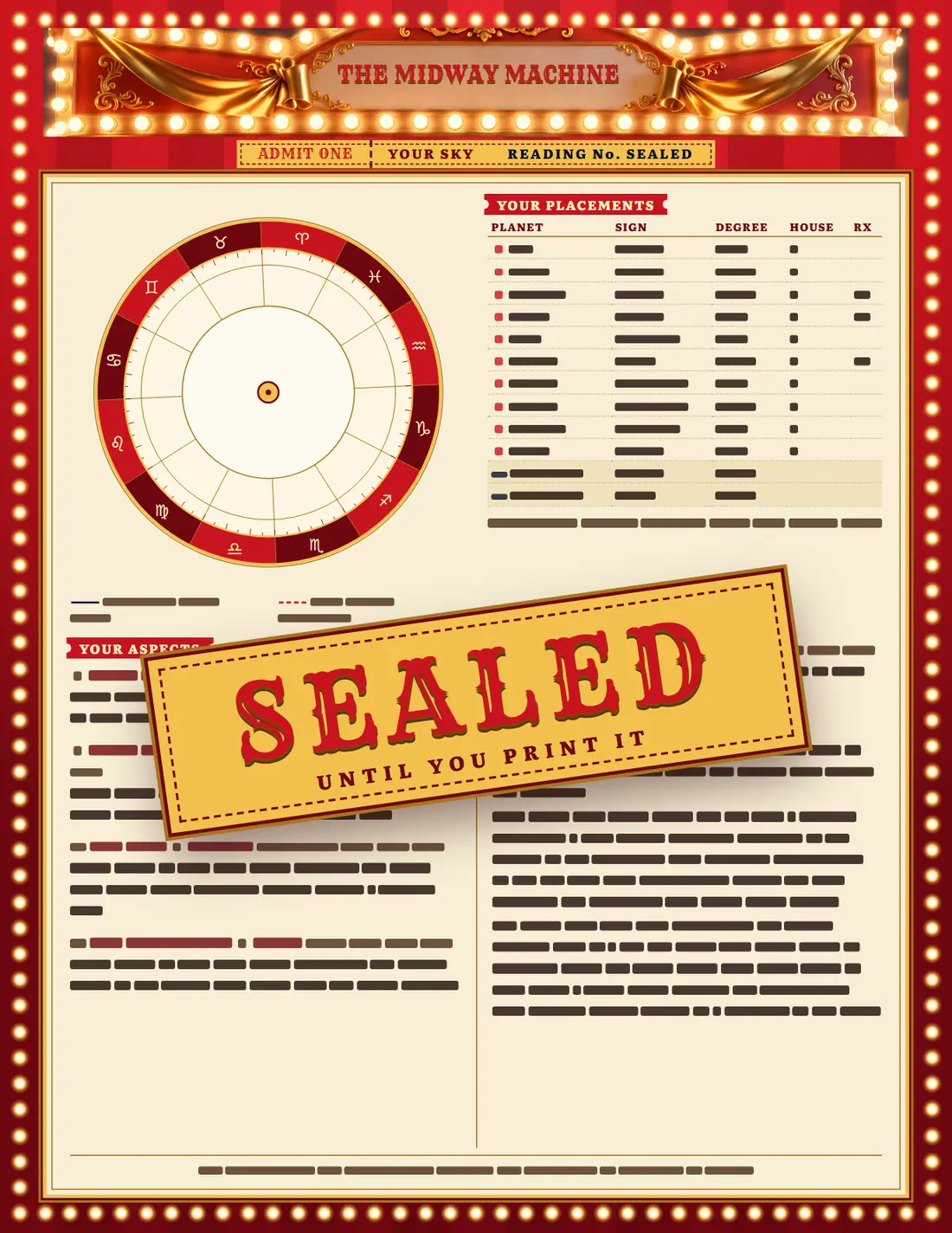 3 Your sky
 4 Love & your people
 5 Work & money
 6 Your year ahead
Sources
- Traditions, Legends, Superstitions, and Sketches of Devonshire on the Borders of the Tamar and the Tavy, Internet Archive (Wellcome Library copy): Anna Eliza Bray, London, 1838, vol. 2, pp. 287–288. Read on .
- Garnets: The Beauty and Utility of a Gem, Library of Congress, In Custodia Legis blog (Francisco Macías, 25 January 2012). Read on .
- Birth Month Flowers and Their Meanings, The Old Farmer's Almanac. Read on .