The Charts
One card, 12 systems, all worked out the same way every time.
Which charts does The Midway Machine use?
The machine reads 12 systems from your name and birthday: the birth chart with its moon sign, rising sign and houses, your sun sign, the love chart, your life path, name numbers and angel number, the year ahead, the long planetary cycles, the Chinese zodiac and old birthday customs. Each has its own page.
Why these charts
The machine only uses systems it can calculate. Every one below starts from something checkable: where the planets really were, what a birth date reduces to, when Lunar New Year really fell. The traditions then say what those facts mean, and those meanings stay sealed on your card.
Some need only your birth date. Some need your birth time and birthplace, because the sky turns once a day and the minute matters. One needs your name. Each section below says which, and links to a page explaining the chart in full: what it is, how it's worked out, and where it came from.
-
The birth chart
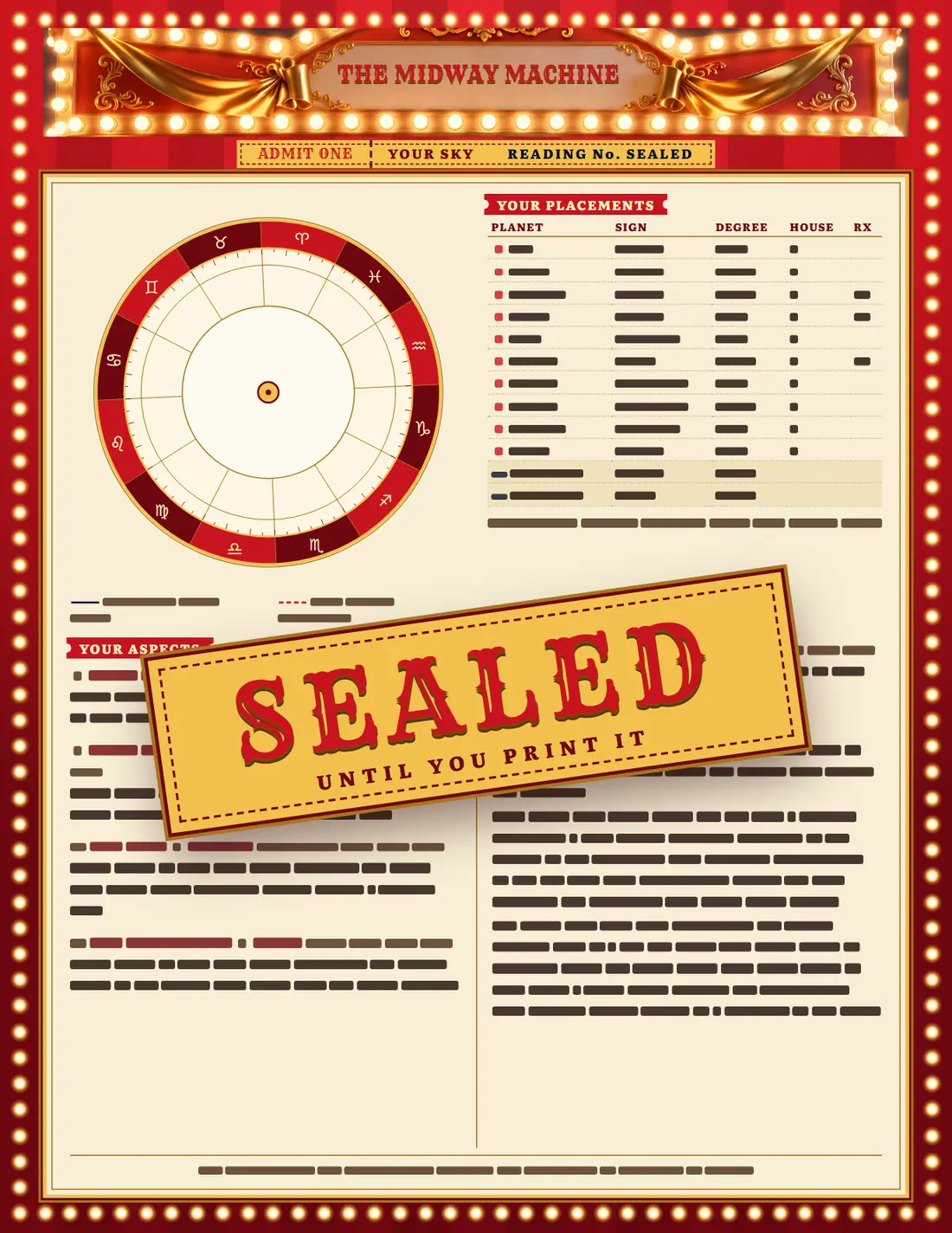
Needs: birth datebirth timebirthplaceOn your card: pages 2 and 3
- What it is
- A map of the sky at the minute and place you were born: the Sun, Moon and eight planets in their signs, the angles between them, and the sky that day.
- Why the machine uses it
- Everything else in Western astrology is a slice of it, and it can be computed exactly, so the machine starts here.
- What it tells you
- Where each planet stood, how they line up with each other, and which slow planets you share with your generation.
- What goes into it
- Real astronomy: planet positions from an open-source ephemeris library for your birth instant, in the tropical zodiac. A birth time and place add the angles and houses.
-
Your sun sign
Needs: birth dateOn your card: page 1
- What it is
- The sign the Sun was in on your birthday, with its decan and any cusp.
- Why the machine uses it
- It's the part everyone knows, and the part most often got wrong near the edges. The machine checks it to the minute.
- What it tells you
- The core of the traditional portrait: element, mode and ruling planet.
- What goes into it
- The Sun's exact position on your birth date. Without a birth time, every time zone on Earth is checked, and a cusp day names both signs.
-
Your moon sign
Needs: birth datebirth timeOn your card: page 1
- What it is
- The sign the Moon was in when you were born.
- Why the machine uses it
- The second light of the chart, and the one most people have never looked up.
- What it tells you
- The inward side the tradition reads alongside the Sun.
- What goes into it
- The Moon's position at your birth minute. It changes sign every two to three days, so without a time the machine prints it only when the whole day agrees.
-
Your rising sign and houses
Needs: birth datebirth timebirthplaceOn your card: pages 1, 3, 4 and 5
- What it is
- The sign rising in the east at your birth, the Midheaven, and the twelve houses counted from them.
- Why the machine uses it
- It is what makes a chart personal to the minute and the town, and the houses are where the card reads your people, work and money.
- What it tells you
- How the tradition says you meet people, and which sign colours each area of life.
- What goes into it
- Your birthplace's latitude, longitude and time-zone rules, the birth time, and spherical trigonometry. Whole-sign houses, the oldest system.
-
Your love chart
Needs: birth datebirth timebirthplaceOn your card: page 4
- What it is
- Venus, Mars, the Moon and the Descendant: the points tradition reads for love.
- Why the machine uses it
- Sun-sign matching is the quick version. The love chart is the version astrologers actually use.
- What it tells you
- How you go about attraction, and which signs fit your chart best.
- What goes into it
- Venus and Mars from the date; the Descendant from the time and place; matches scored from all of them plus the traditional sun-sign pairings.
How your love chart works → · Sun-sign compatibility chart →
-
Your life path number
Needs: birth dateOn your card: page 1
- What it is
- The single number a birth date reduces to in Pythagorean numerology.
- Why the machine uses it
- It's numerology's core number, and it can be checked with a pencil.
- What it tells you
- Numerology's headline number for you, 1 to 9 or a master number.
- What goes into it
- Month, day and year each reduced to one digit, added, and reduced again, keeping 11, 22 and 33 whole.
-
Your name numbers
Needs: nameOn your card: page 1
- What it is
- Expression, soul urge and personality numbers from the letters of your name.
- Why the machine uses it
- The only part of the card that comes from your name rather than your birthday.
- What it tells you
- How numerology reads the way you come across and what you want underneath.
- What goes into it
- Letters valued 1 to 9 in cycles (A=1, J=1, S=1), totalled for all letters, vowels and consonants.
-
Your angel number
Needs: birth dateOn your card: page 2
- What it is
- Your life path written as a repeating number, the way angel-number writing presents it.
- Why the machine uses it
- People see repeating numbers everywhere. This is the one tied to your own birthday, and it always agrees with your life path.
- What it tells you
- The repeating number angel-number tradition would call yours.
- What goes into it
- Your life path, repeated: 7 becomes 777, and a master number like 11 becomes 1111.
-
Your year ahead
Needs: birth dateOn your card: pages 5 and 6
- What it is
- The year from the day your card prints, set by two clocks.
- Why the machine uses it
- A birth chart never changes. A year page needs something that moves.
- What it tells you
- The theme of the year, where the tradition says luck lands, and month-by-month moods.
- What goes into it
- Numerology's personal year (birth month and day plus this year) and Jupiter's current sign counted from your sun sign.
-
Your returns and turning points
Needs: birth dateOn your card: pages 2 and 6
- What it is
- The long clocks: Saturn and Jupiter returns, and numerology's four pinnacles.
- Why the machine uses it
- They are the dates in a chart you can put in a diary, and every one of them can be checked.
- What it tells you
- When your turning points fall, past and coming.
- What goes into it
- Exact dates when Jupiter and Saturn come back to their birth degrees, and pinnacle ages from your life path.
-
Your Chinese zodiac
Needs: birth dateOn your card: page 1
- What it is
- Your animal and element in the twelve-year, sixty-year Chinese cycle.
- Why the machine uses it
- A second, independent tradition, and the one people most often get wrong in January and February.
- What it tells you
- Your animal and its element, counted the traditional way.
- What goes into it
- Your birth year counted from the real Lunar New Year, worked out from the new moons and the winter solstice in Beijing time.
-
Your birthday lore
Needs: birth dateOn your card: page 2
- What it is
- The weekday rhyme, your birthstone and birth flower, and the days you have been alive.
- Why the machine uses it
- Old calendar customs people still love, and the oldest birthday fortune-telling there is.
- What it tells you
- Which line of the rhyme is yours, your stone and flower, and your next day-count milestone.
- What goes into it
- Calendar arithmetic: the weekday of your birth date, the month, and a count of days.
And then the machine's reading
The front of the card, who you are, your gifts and your challenges, isn't one more chart. It's the machine weighing the charts above against each other: your sun sign, Moon, rising sign and numbers each lean certain traits forward, and where they agree the card says so. How the Machine Works explains the weighing; the result is sealed.
Every chart, on one card
See all six pages, sealedFold the pages back
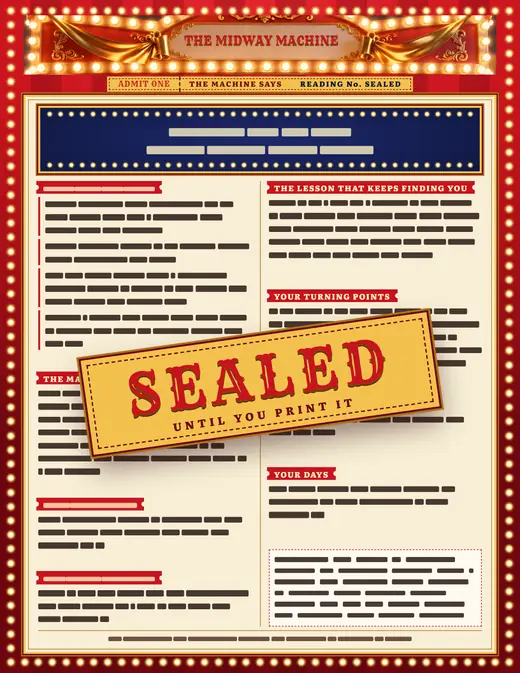
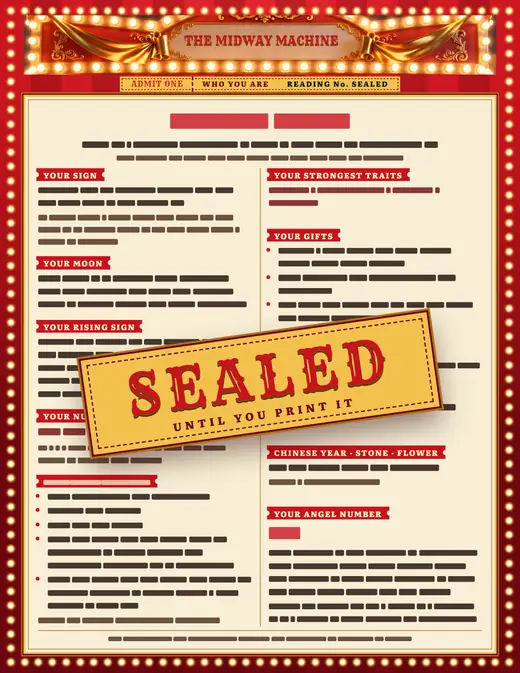
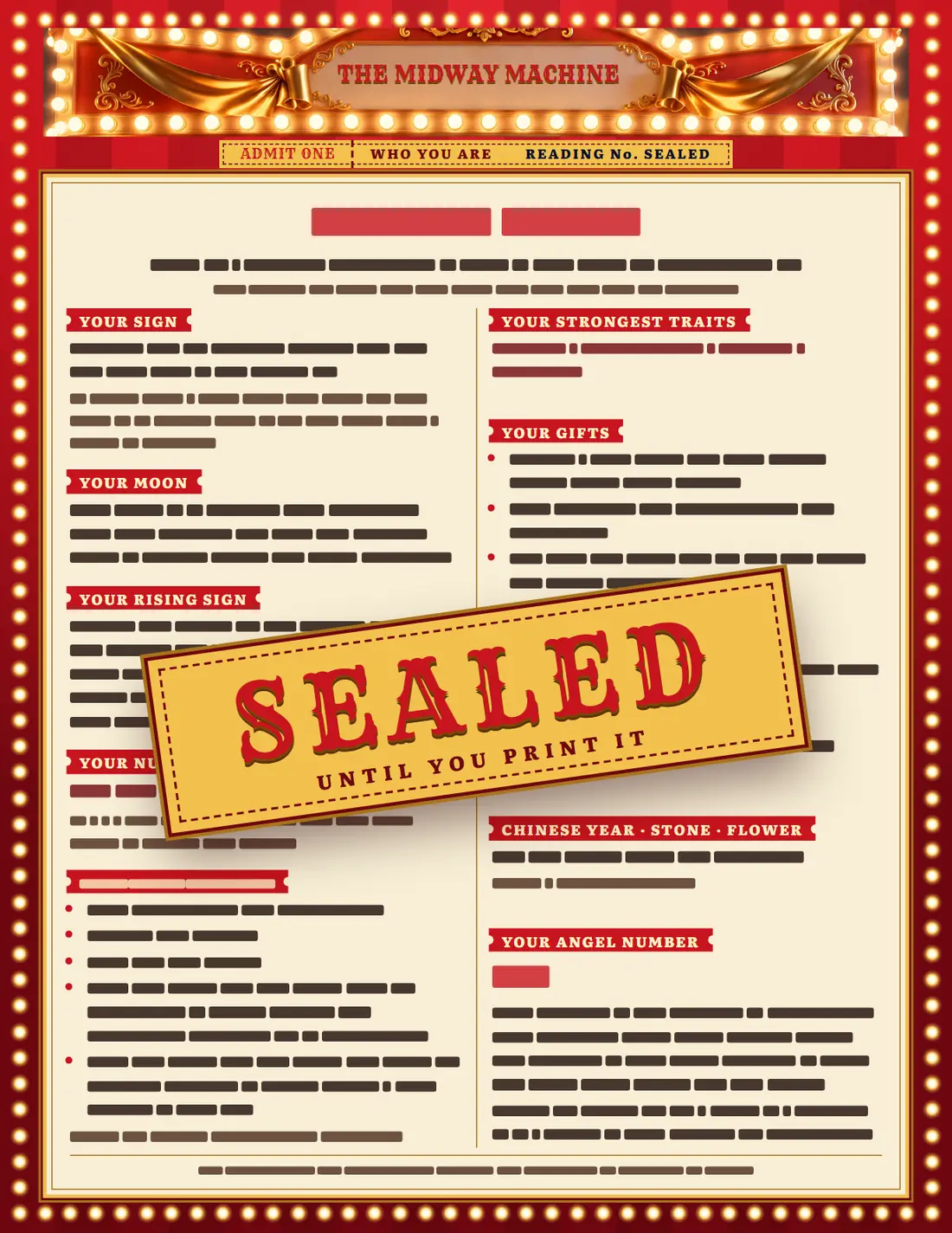 1 Who you are
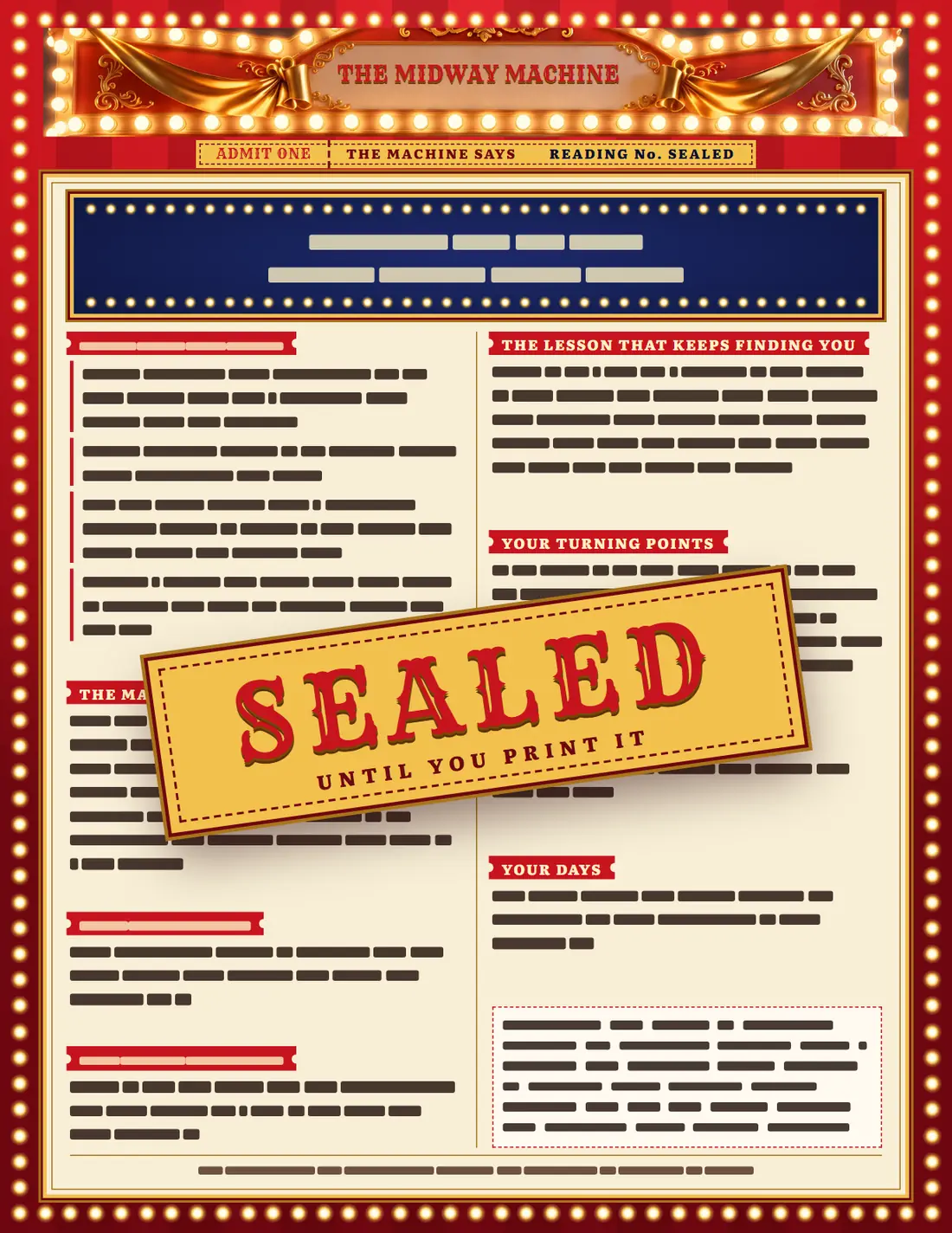 2 The machine says
 3 Your sky
 4 Love & your people
 5 Work & money
 6 Your year ahead
For entertainment and self-reflection. Astrology and numerology are traditions, not science.
Spotted something wrong, out of date or missing? The corrections page says how we fix it.